HRV or ERV: which one should you choose for a home in Quebec?
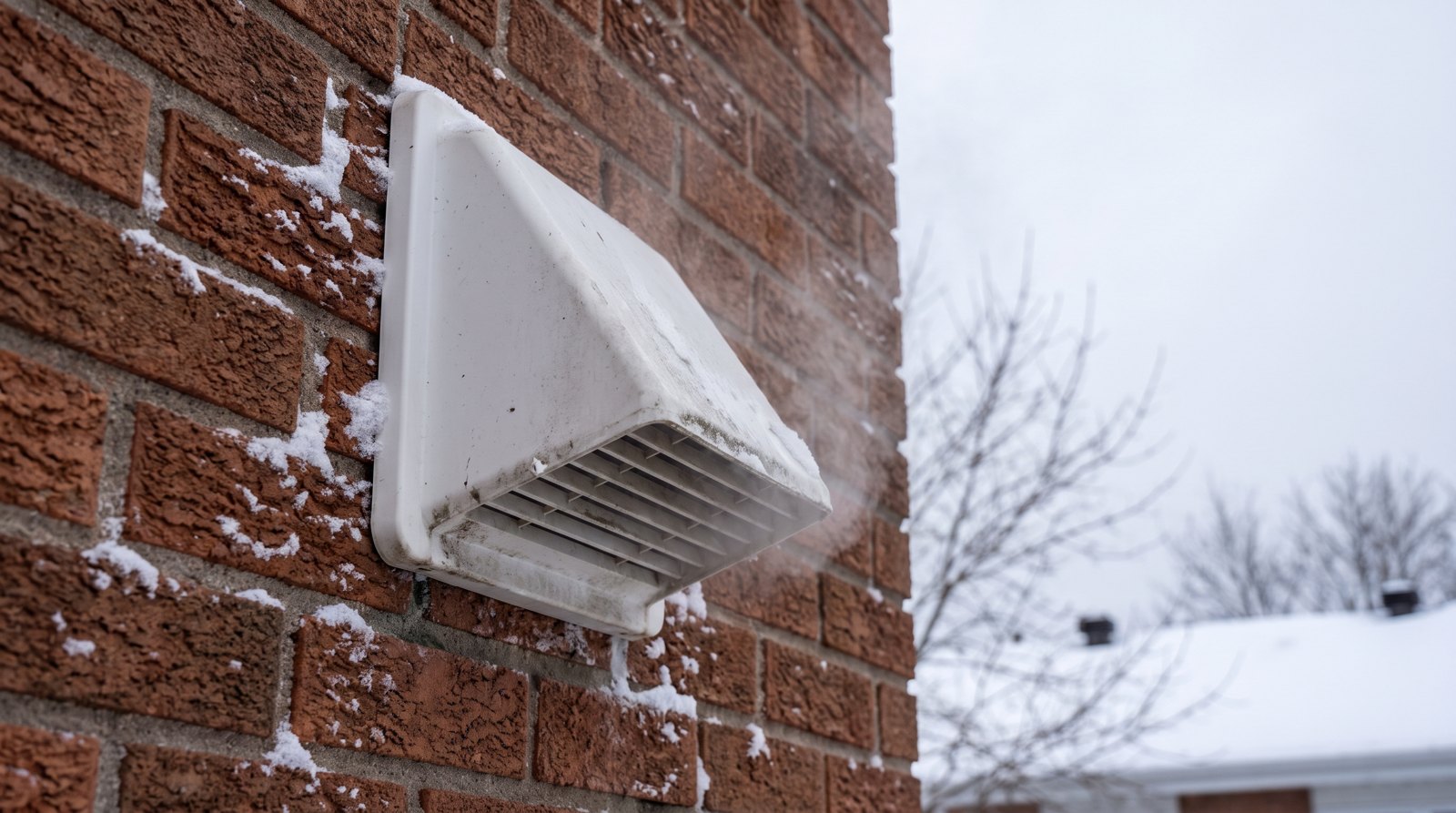
HRVs and ERVs both recover heat from exhaust air, but only an ERV also transfers a portion of the humidity. The right choice depends on how your home behaves in winter: if the air is too humid, an HRV is a good fit, while if the air is very dry, an ERV may be justified.
Key points
- An HRV transfers heat only. An ERV transfers both heat and moisture between two separate air streams.
- Humid home in winter: an HRV removes water vapor along with the stale air, which limits condensation on windows.
- Very dry home in winter: an ERV can help keep indoor air from becoming too dry.
- New construction: according to the Government of Quebec, the installation of an HRV is mandatory.
- The Quebec Construction Code applies. The system must be designed by a qualified professional.
- Maintenance is just as important as the choice of model. The exchanger and ducts must remain accessible at all times.
What an HRV and an ERV do
A mechanical ventilation system extracts indoor air to the outside and simultaneously introduces fresh outdoor air. This is the basic principle of heat recovery ventilation systems and an air exchanger, whether it is an HRV or an ERV.
A heat recovery ventilator (HRV) recovers energy from exhaust air in cold weather. It then transfers that energy to the incoming fresh air. Exhausting is generally done in bathrooms. Fresh air is distributed to the living room, bedrooms, and closed rooms.
An Energy Recovery Ventilator (ERV) works in the same way. These recovery ventilators differ from simple exhaust fans, which vent air without recovering its energy. Both are single-unit systems. Their core, the core, is where heat passes from one stream to the other, with both airflows remaining separate.
This ventilation serves a practical purpose. It removes odors, excess humidity, and pollutants, and it contributes to the comfort and health of the occupants. This air exchange is the foundation of good indoor air quality, and the quality of the ventilator and the core determines its efficiency. Installing a ventilation system is a necessity for almost every home.
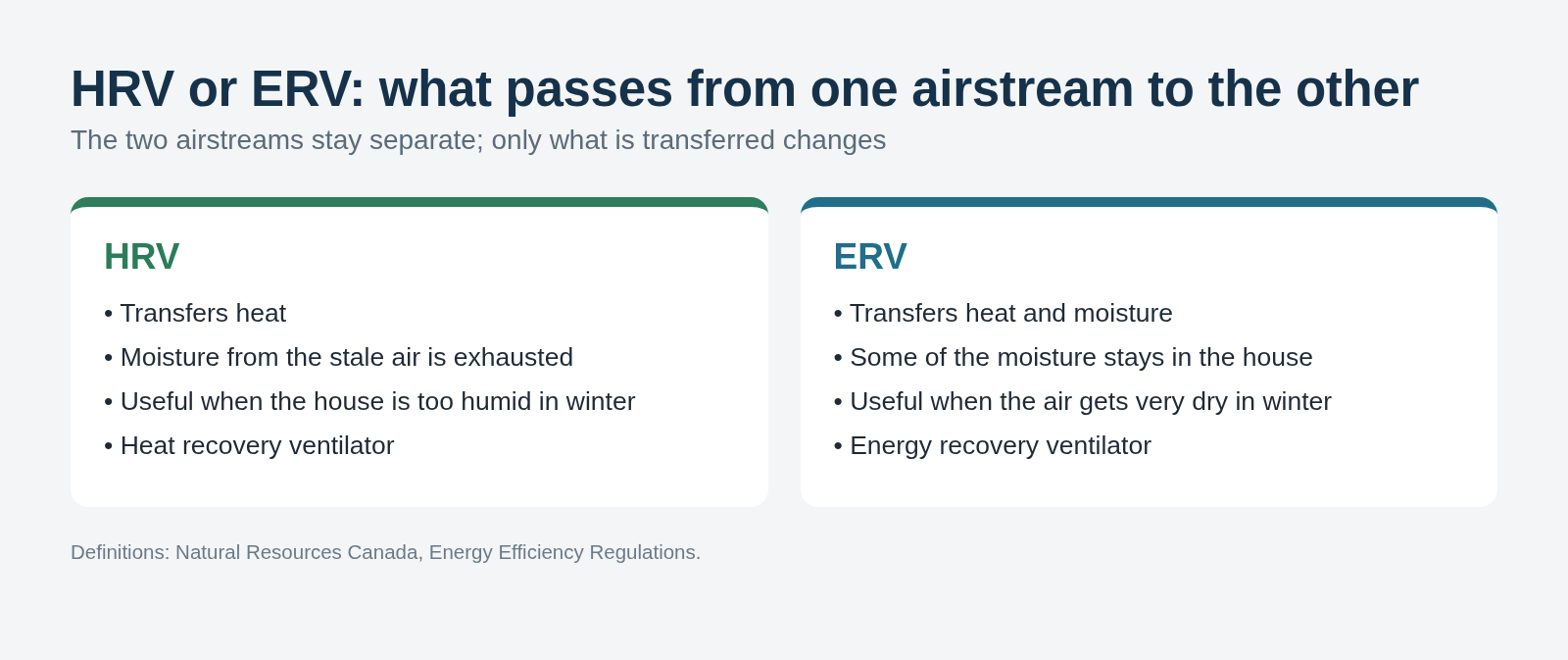
HRV or ERV: what passes from one airflow to the other.
The difference: heat only or heat and humidity
The only real difference lies in water vapor. The HRV transfers heat. The ERV transfers heat and humidity, according to the definitions from Natural Resources Canada.
In both cases, the exhaust air and the incoming air do not mix. Only energy passes from one stream to the other: fresh air arrives less cold, which preserves comfort and reduces heating costs. The choice between an HRV and an ERV therefore comes down to one question: do you want water vapor to leave with the stale air, or do you want some of it to remain in the house?
Home too humid in winter: the HRV
If your home is humid during the cold season, an HRV is generally the logical solution. Insufficient ventilation leads to excess humidity, condensation, premature deterioration of the home and mold.
The most visible sign is condensation on the windows, a signal that the current exchanger is insufficient or that there is no mechanical ventilation. An HRV refreshes the air and vents humid air outside, all while recovering heat. In fact, the government recommends choosing an HRV for keep energy bills at an acceptable level.
A few simple steps can complement the unit:
- Use the range hood, which vents cooking fumes directly outside.
- Add a standalone bathroom exhaust fan if the HRV doesn't handle it.
- In winter, open two windows for two to three minutes, depending on the outside temperature, to clear out steam.
To better understand your readings, check out our guide on home humidity levels.
Summer requires a different approach. If the outdoor relative humidity exceeds 70%, the government recommends using a dehumidifier. Bringing that air inside would make the basement more humid, as explained on our humidity page.
Very dry air in winter: when an ERV is the right choice
An ERV is justified when the air in your home becomes too dry during cold weather. Excessive ventilation can bring in a lot of cold, dry air. This increases heating costs and causes discomfort, such as dry eyes and nosebleeds.
Since an ERV also transfers moisture, it retains some of the indoor humidity in the incoming air. The fresh air therefore arrives slightly less dry than with an HRV. This doesn't replace proper system design, but it can help.
Before concluding that your home needs an ERV, check a few things:
- Is the exchanger properly adjusted, without ventilating more than necessary?
- Is the number of occupants low, resulting in little steam produced indoors?
- Is the home airtight enough to retain that moisture?
The how an air exchanger works in winter can also explain certain discrepancies. A technician can assess the situation before any changes are made.
Airtightness and the number of occupants
A home's airtightness significantly impacts indoor humidity. In a poorly sealed house, air leaks can account for 25% of heat loss. Poor airtightness can drive up energy bills by as much as 15%.
These leaks also transport water vapor. Exfiltrating warm air can cause hidden condensation, damage insulation, and promote mold growth as well as structural rot. The vapor barrier must be continuous and located on the warm side of the insulation.
A blower door test locates leaks and measures the air entering the home. This test also helps ventilation technicians determine if the dwelling is airtight enough to retain its vapor. When sealing, start at the top of the residence and in humid rooms like bathrooms.
The number of people in the home is also a factor. More people means more showering, cooking, and laundry. A large family generally produces more vapor than a single person, which points toward using an HRV to exhaust it.
What the regulations say
Mechanical ventilation must comply with the Quebec Construction Code. The system must be designed by a qualified professional. For new homes, the government mandates that installing an HRV is mandatory.
Regarding the equipment, Natural Resources Canada specifies that heat recovery ventilators manufactured on January 1, 2020 or later must comply with the regulations. The testing standard is CAN/CSA-C439-18. The maximum rated airflow is no more than 142 L/s (300 cfm) at 0°C.
To compare two exchangers, check their technical specifications: compliance with the testing standard, heat recovery efficiency, and, if applicable, the Energy Star rating. For a specific project, especially if you are considering an ERV, ask a professional to confirm what applies.
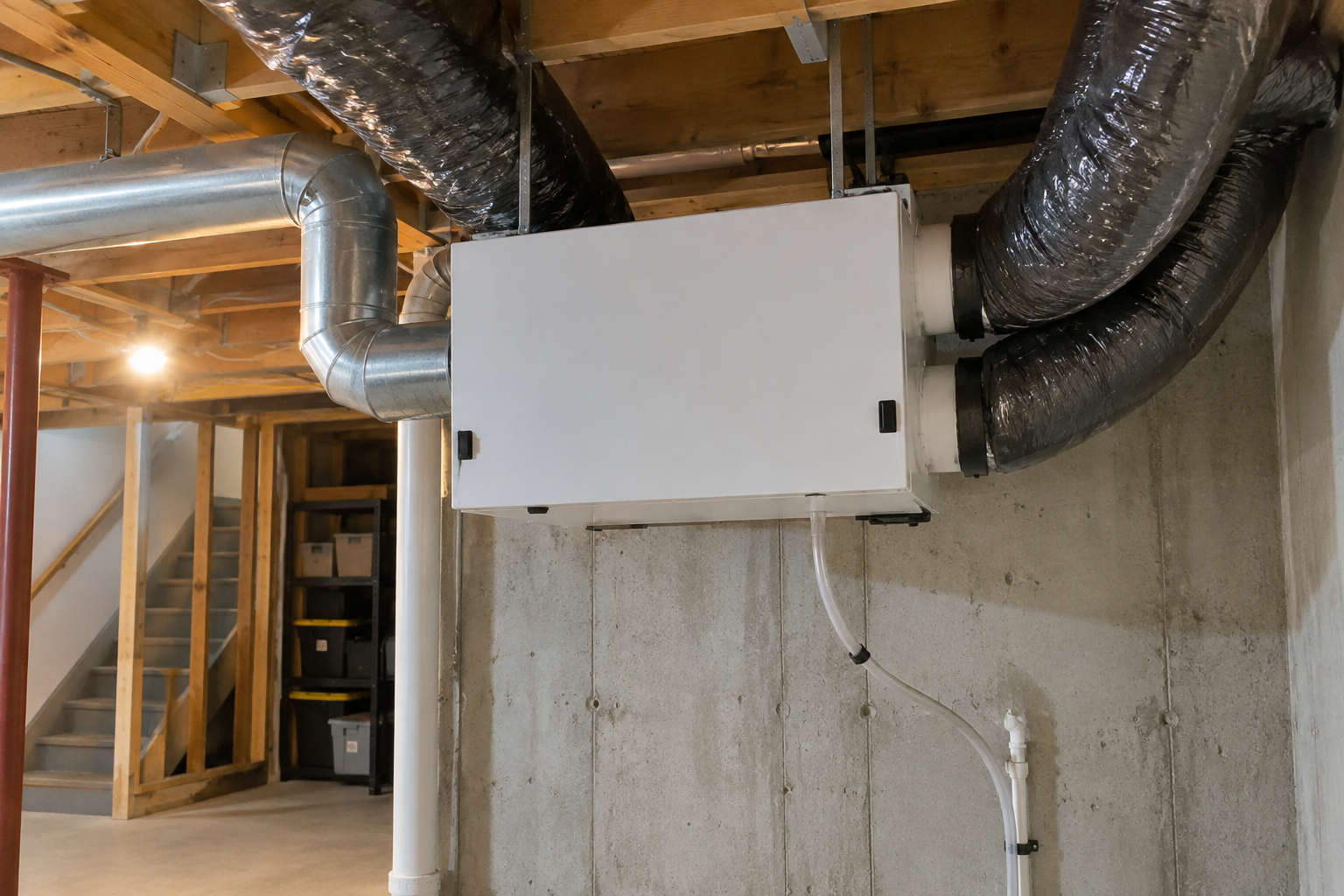
An accessible basement heat exchanger with rigid, insulated ducts.
Installation and maintenance
Whether you choose a heat recovery or energy recovery ventilator, a properly installed unit performs better and is easier to maintain. Rigid, airtight ducts are preferred for airflow. The unit and ducts must remain accessible at all times for cleaning and regular maintenance.
Maintenance is a key factor to consider. Both systems require regular upkeep according to the manufacturer's instructions, particularly for the core and filters. A wall-mounted control allows you to adjust the speed as needed. The exchanger operates independently of your heating system, whether you have baseboard heaters or a heat pump, and it continues to ventilate during the cooling season. A neglected exchanger will not ventilate effectively, regardless of the type. If you know you will have trouble maintaining it, choose an easily accessible location.
To learn about the steps involved in a project, visit our page on air exchanger installation.
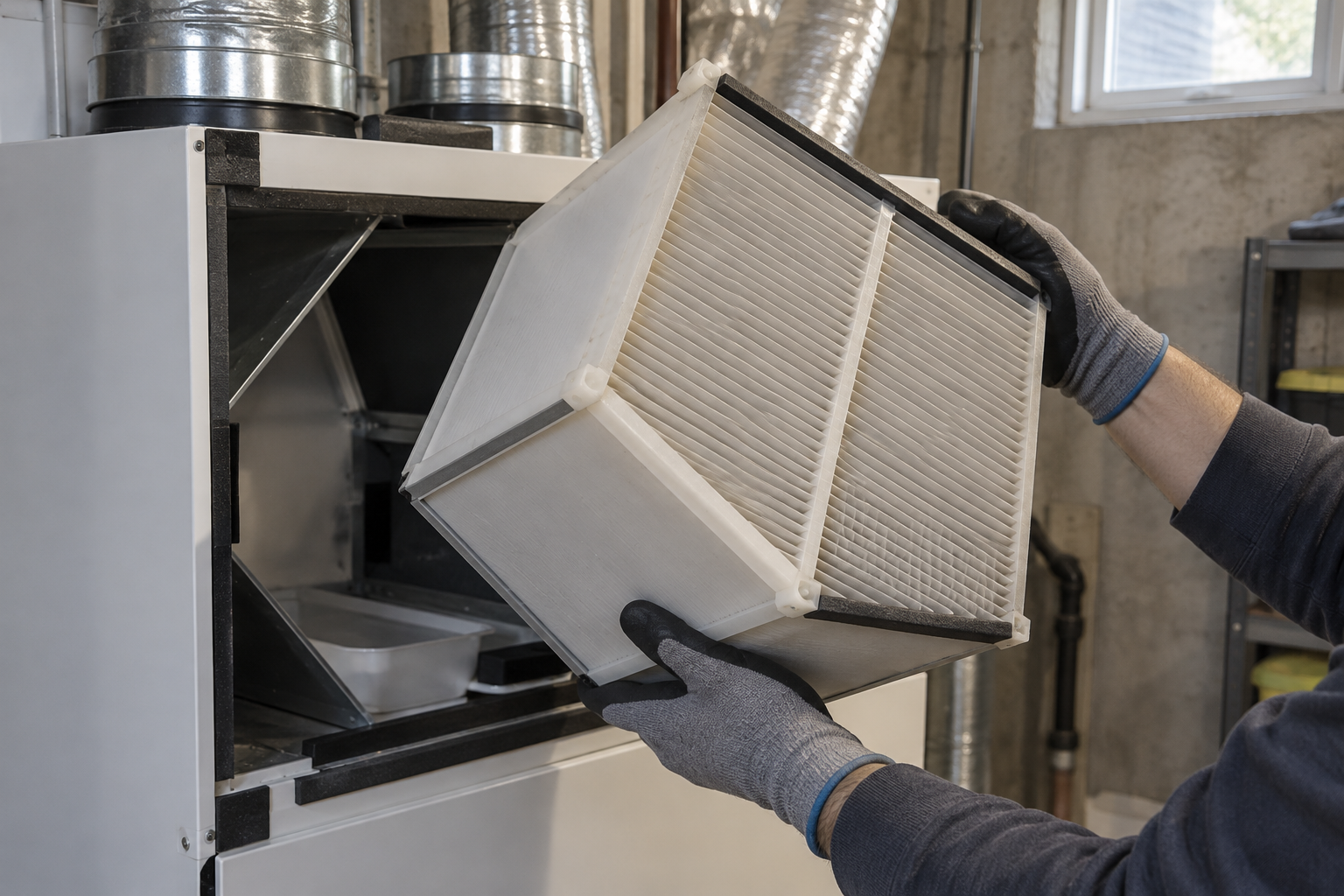
The core can be removed for maintenance according to the manufacturer's instructions.
How to decide for your home
Start by observing your home during cold weather. Air behavior will tell you which direction to take.
- Condensation on windows, lingering odors: an HRV is the natural choice.
- Dry skin and eyes, nosebleeds: an ERV is worth considering.
- Large family: the moisture produced points toward an HRV.
- Very airtight home with low occupancy: an ERV can help keep the air from getting too dry.
- New construction: an HRV is mandatory according to government regulations.
If the signs are contradictory, measure before deciding. A simple hygrometer, placed away from the exchanger, gives an initial idea of the actual humidity level. A technician can then evaluate the existing ventilation, airtightness, and air distribution throughout the rooms.
When to call a technician
Call a technician if humidity or dryness persists despite proper use of the exchanger. You should also do so before replacing an HRV with an ERV, or for any ventilation project in a new or renovated home.
We serve the North Shore, including ventilation in Laval, ventilation in Terrebonne and ventilation in Saint-Eustache. These pages outline the services available in each city.
Frequently asked questions about HRV and ERV
.webp)
Guarantee: No traces, no stress — only lasting results.
5,000+
96%
$6,275
.avif)
.webp)