Converting from oil heating in Quebec: rules, options, and steps

The conversion of oil heating systems is permitted in Quebec, provided the unit is replaced with a non-fossil fuel system, such as a heat pump or an electric furnace. As of December 31, 2023, natural gas is no longer an option for replacement in existing residences.
Key points
- Since December 31, 2023, it is prohibited to install an oil-fired appliance in an existing residential building.
- Replacement with a fossil fuel system is prohibited, including renewable natural gas.
- Equipment age matters : a boiler or hot air furnace installed more than 20 years ago (water heaters: 10 years) can no longer be repaired, with the exception of maintenance, motors, and controls.
- The contractor must declare the work online within 30 business days.
- The Chauffez vert program ended on March 31, 2026, but grants of up to $5,400 are available for the heat pump units we install.
- Electric options include heat pumps, electric furnaces, electric boilers, and thermal storage units.
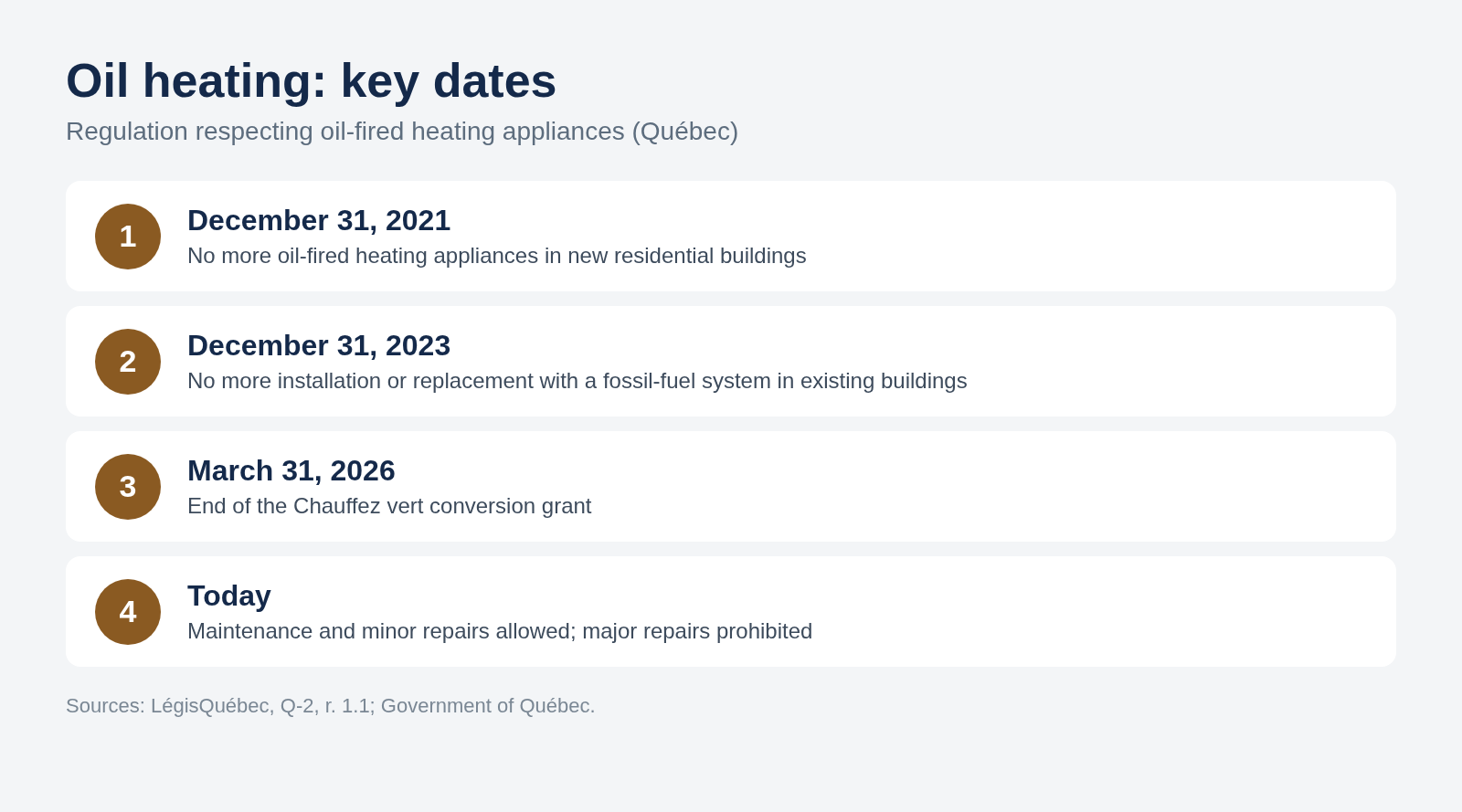
Important dates for oil heating.
What the law has prohibited since 2021 and 2023
The Regulation respecting oil-fired heating appliances aims to reduce greenhouse gas emissions linked to home heating. It distinguishes between new and existing buildings.
A residential building is at most 600 m² and has no more than 3 stories. Its primary use is residential, and it contains only dwellings. A bungalow, cottage, semi-detached house, duplex, or triplex meeting these limits falls under this definition.
A building is considered "existing" if its building permit was issued before December 31, 2021. It is "new" if the permit is dated on or after that day.
The prohibitions do not apply to buildings connected to an off-grid electricity distribution network, such as those in the Magdalen Islands.
Maintaining or repairing an existing oil-fired appliance
The regulation primarily targets the age of the equipment. According to the Government of Quebec, routine maintenance remains permitted. However, the regulation prohibits repairing a boiler or furnace installed more than 20 years ago, or a water heater installed more than 10 years ago.
Even in these cases, certain work remains permitted: maintenance according to the CSA B139 standard, repair of the motor and its moving parts, and repair of the electronic or electrical control components. However, repairing or replacing the combustion chamber or heat exchanger is prohibited.
Maintenance and minor repairs do not require a declaration. This work must still be entrusted to qualified professionals, such as members of the Corporation des maîtres mécaniciens en tuyauterie du Québec (CMMTQ).
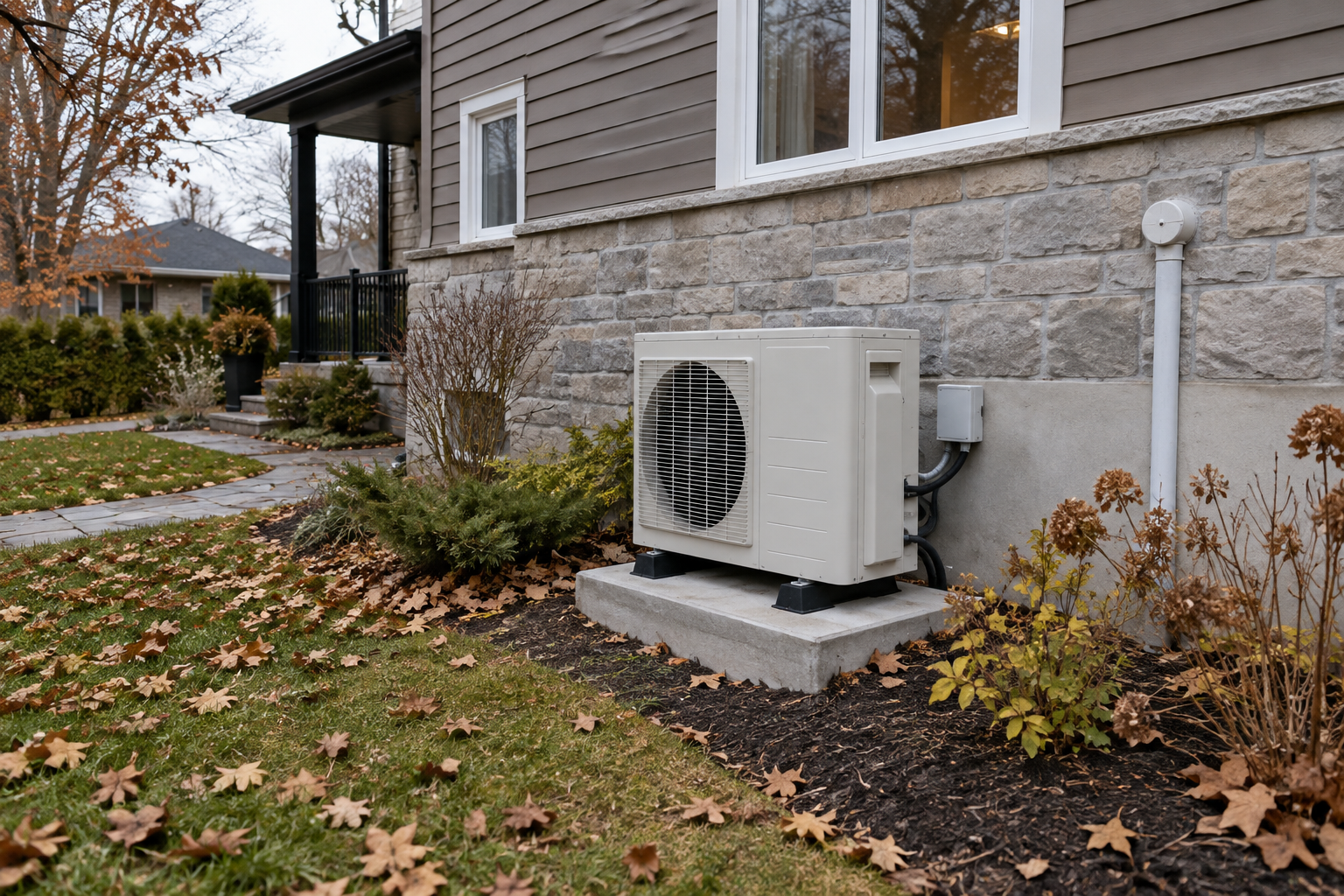
A central heat pump, the most common replacement option.
Replacement options
For your heating system, the replacement must use a non-fossil energy source. The government recognizes electric furnaces, electric boilers, heat pumps, thermal storage units, and biomass appliances. Natural gas is excluded.
The heat pump
The heat pump is often the first choice for a conversion because it offers good energy efficiency. It is available in air-source or geothermal versions. Our wall-mounted and central heat pumps cover both major types of installation.
It can also provide air conditioning in the summer. To compare systems, consult our guide heat pump vs. electric furnace: how to make the right choice for your home.
The electric furnace
The electric furnace directly replaces an oil-fired hot air furnace. In most cases, it uses the existing ductwork. It is the only type of furnace we install.
It works well on its own or as a backup to a heat pump. Visit our page on furnaces or the article on the different types of furnaces for winter heating.
Electric boilers or heat accumulators
If your home uses hot water radiators, the electric boiler replaces the oil boiler. Thethermal storage unit stores heat and releases it as needed. These are both recognized options. A technician can confirm which one is suitable for your distribution system.
Steps for a conversion
An heating system conversion follows a logical order, from assessment to declaration. Here is the typical process:
- Assessment: a technician examines your current equipment, heat distribution, and electrical supply.
- Selection: you choose the electric system best suited to your home and budget.
- Installation: the installation work is carried out by qualified professionals.
- Tank removal: the tank and the old system are dismantled according to standards.
- Declaration: the contractor submits the information online.
An energy assessment of the residence helps determine the right capacity. It prevents buying equipment that is too small or too large.
Do you live in Laval, Terrebonne, or Saint-Jérôme? Our pages on oil tank removal in Laval, in Terrebonne and in Saint-Jérôme explain how we carry out our work.
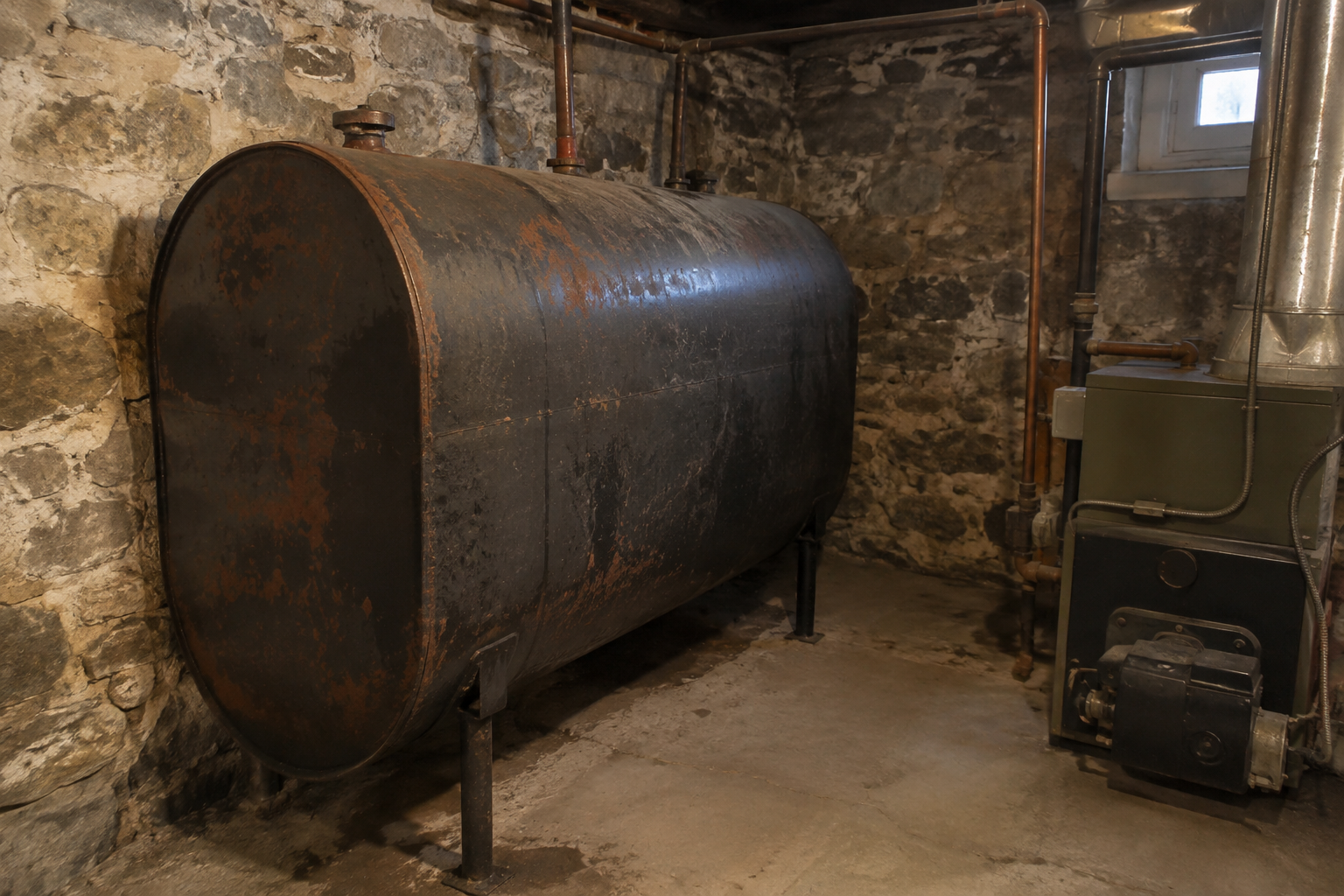
An oil tank in the basement: its removal is part of the conversion process.
Tank removal and declaration
The oil tank removal must comply with current standards. Professionals also report removal work online. Our page on oil and heating oil tank removal details this step.
Anyone replacing an oil-fired appliance with another energy source must submit a declaration to the minister within 30 business days. It must include:
- the installer's name, address, phone number, and license number;
- detailed information about the installed equipment and the building;
- a description of the tank removal procedure, if applicable.
While this process is the contractor's responsibility, it serves to protect you. Failure to declare results in an administrative monetary penalty of $350 for an individual or $1,500 in other cases. Installing a fossil fuel system to replace oil results in $1,500 for an individual, or $7,500 in other cases.
Financial assistance in 2026
The Chauffez vert program ended on March 31, 2026. To be eligible, work had to be completed and the application submitted before that date.
The Government of Quebec also mentions the Affordable Heating Oil Conversion to Heat Pumpprogram, which supports replacing oil-fired systems with high-energy-efficiency heat pumps. As for us, the assistance can reach up to $5,400 with the equipment we install. Eligibility requirements apply to homeowners, so verify them before signing.
Keep your invoices and proof of work. They are required for any grant application and for the contractor's declaration.
How many homes still use oil heating
Fewer than 200,000 homes still use oil in Quebec, according to the Government of Quebec. This fuel accounts for approximately a quarter of greenhouse gas emissions in the residential sector.
For the same amount of energy, oil emits 100 times more carbon than hydroelectricity. Its use generates over 500,000 tonnes of CO2 per year, equivalent to 190,000 cars. Its combustion also releases nitrogen oxides, sulfur dioxide, and fine particles.
These facts explain the shift toward electric heating. Its advantages include the absence of combustion in the home and no tank to monitor.
Frequently asked questions about converting from oil heating
.webp)
Guarantee: No traces, no stress — only lasting results.
5,000+
96%
$6,275
.avif)
.webp)