Hydro-Québec heat pump rebate: what LogisVert is really worth in 2026
Hydro-Québec provides $50 per 1,000 BTU/h at -8 °C for an ENERGY STAR certified heat pump, and $120 per 1,000 BTU/h at -8 °C for cold-climate models. The LogisVert program caps the financial assistance at $6,700 for the Heat Pump measure.
Key points
- The grant is calculated based on the heating capacity at -8 °C, not on the price paid or the cooling capacity.
- The outdoor unit must have a minimum capacity of 12,000 BTU/h in cooling mode and the complete system must be new and ENERGY STAR certified.
- The financial assistance can never exceed 100% of the purchase and installation cost.
- A single application combining two different measures qualifies for a bonus of 5% of the total amount.
- In areas of energy poverty, the Multi-unit bonus increases the aid to $220 per 1,000 BTU/h for installations completed since June 15, 2026.
- The application must be submitted no later than nine months after installation, and processing takes 10 to 12 weeks.
How much is the LogisVert grant actually worth
The amount depends on a single technical figure: the heat pump's heating capacity measured at -8°C. Hydro-Québec offers financial assistance of $50 per 1,000 BTU/h at -8°C for the purchase and installation of an ENERGY STAR certified heat pump, and $120 per 1,000 BTU/h at -8°C when it is also a "cold climate" model, according to the LogisVert program participation guide (June 15, 2026 version). The program page advertises a grant of up to $6,700 for a heat pump.
The difference between $50 and $120 changes everything. For the same 24,000 BTU/h unit at -8°C, the difference between a standard ENERGY STAR certification and a cold climate certification represents $1,680 in additional aid. This is often more than the price difference between the two models, and it is the first thing to look at before signing a quote.
These amounts are calculations based on rates published by Hydro-Québec. The capacity at -8°C is found in the unit's technical specifications, not on the packaging: ask your installation company for it before purchasing. Our guide on the ideal heat pump capacity for your home explains how this value is determined.
Requirements the unit must meet
The complete system, including both the outdoor and indoor units, must meet four requirements. It must be new, ENERGY STAR certified, include an outdoor unit with a minimum rated capacity of 12,000 BTU/h in cooling mode, and have been purchased from a store in Quebec or online from a company with a Quebec address.
Two configurations are eligible: the air-source split-system heat pump, i.e., the central heat pump with one indoor unit and one outdoor unit, and the air-source mini-split heat pump, i.e., the wall-mounted unit with one or more indoor units. Before choosing a model, check that it appears on the list of eligible heat pumps published by Hydro-Québec: a high-performance unit that does not appear on this list is not eligible for any subsidy. Replacing a geothermal heat pump follows a different scale, at $250 per 1,000 BTU/h.
Check the list of eligible heat pumps
Hydro-Québec publishes a list of heat pumps eligible for the LogisVert program online. This list, not the manufacturer's sales brochure, determines a model's eligibility and the amount of financial aid based on the installation date. A search tool allows you to filter by unit type, model, and energy efficiency level.
Three habits can help you avoid unpleasant surprises. Note the exact model number of the outdoor and indoor units, as the same product line may contain both eligible and ineligible combinations. Check if the model is labeled for cold climates, which increases the offer from $50 to $120 per 1,000 BTU/h. Finally, ask the company to include the AHRI or ENERGY STAR number on the quote before the work begins, rather than trying to find it after the fact.
Efficient heat pumps stand out for their ability to produce heat when the temperature drops. Two units sold at the same price can have very different capacities at -8°C, resulting in subsidies that vary by several hundred dollars for a comparable heating system.
Requirements for the company performing the work
The company performing the installation must be registered with the Registraire des entreprises du Québec, hold the appropriate licenses from the Régie du bâtiment du Québec given the work to be performed, and be a member of the professional association for their sector. These three conditions are verified at the time the application is processed, not at the time the work is performed.
This is the point that causes the most applications to fail. An installer without a valid RBQ license or one not registered with the business registrar makes the application ineligible, even if the unit is perfect and the installation is impeccable. Ask for the RBQ license number before the work begins and verify it in the Régie's public registry.
Work that is not eligible for any benefits
Four situations are explicitly excluded from the program:
- The installation of indoor units, including the air distribution system, outside the insulation envelope, for example in an attic or an unheated crawl space.
- Replacing a single coil, a single indoor unit, or a single outdoor unit.
- Replacing a heat pump following a breakdown covered by a warranty or insurance.
- The installation or replacement of a central heat pump in a home equipped with a geothermal system.
The first case often surprises owners of older homes where the distribution system runs through the attic. In this type of building, a well-placed wall-mounted unit remains eligible where a central system is not.
Electrical and installation requirements
A central or wall-mounted heat pump is added to the home's electrical system. The panel must have the necessary capacity to accommodate the new circuit, and electrical work must be performed by companies holding the required licenses from the Régie du bâtiment du Québec. The program does not subsidize this upgrade, but an application with non-compliant installation remains ineligible.
Indoor units must be located within the insulation envelope. In a house where the air distribution system runs through an unheated attic, bringing this system up to code becomes a prerequisite, not an extra. Discuss this point with your contractor during the initial visit, as it affects both the cost of the work and the eligibility of your application.
The two bonuses that increase the amount
The Multiple measures bonus adds 5% of the total amount of the financial assistance when a single application includes at least two different eligible measures. The measures must be implemented in the same dwelling within a nine-month period. If Hydro-Québec ultimately approves only one measure after validation, the bonus is forfeited.
The bonus Multi-unit residential, meanwhile, is intended for owners where each tenant has their own electricity account. It adds $100 per 1,000 BTU/h at -8°C, bringing the assistance to $220 per 1,000 BTU/h for a cold-climate ENERGY STAR certified wall-mounted unit, for installations completed on or after June 15, 2026, as specified on the Multi-unit residential bonus page. The building must be located in a designated energy poverty zone by postal code, have been built in 1995 or earlier, have a property value per unit lower than the median for its administrative region, be heated primarily by electricity, and have one electricity meter per unit.
The two bonuses cannot be combined. An owner who receives the Multi-unit residential bonus also cannot include the subsidized equipment in the calculation of a rent increase, a rule linked to the Tribunal administratif du logement.
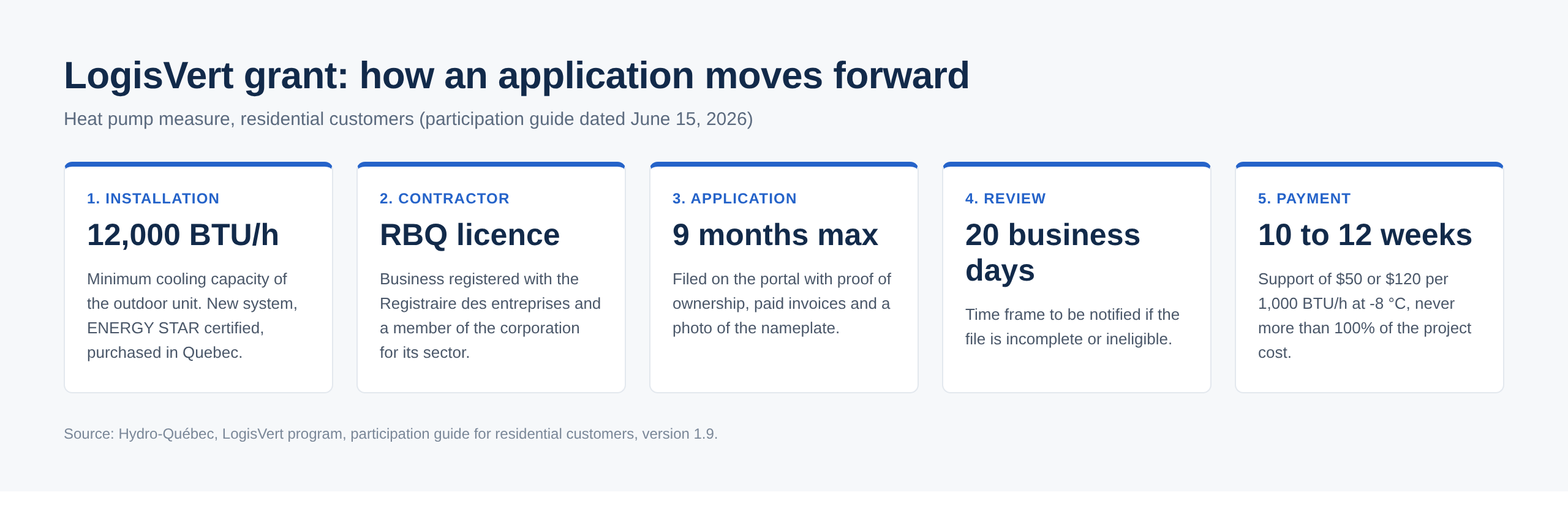
The complete LogisVert application process, Heat Pump measure.
Step-by-step instructions
Everything is handled through the logisvert.ca portal. You create a participant profile, then fill out one form per eligible dwelling. Applications sent by email or mail will not be processed.
Three documents are required for the Heat Pump measure: proof of ownership (property tax statement or the first page of the deed of sale), the paid invoices, and a clear photo of the nameplate on the outdoor unit showing the model number and serial number. The invoice must include its number and date, the installation date, the customer's name, the installation address, the company name, its GST and QST numbers, its RBQ license number, a description of the work, the AHRI or ENERGY STAR number, and the cost of the work. An incomplete invoice is the second most common reason for rejection after licensing issues.
In practice, gather these documents before even submitting your application:
- Copy of the property tax statement or the first page of the deed of sale.
- Copy of the paid invoices for the purchase and installation, including the RBQ license number and the GST and QST numbers of the companies involved.
- Photo of the outdoor unit's nameplate; one photo per installed model.
- Energy efficiency data sheets confirming ENERGY STAR certification and, if applicable, the cold climate designation.
These documentation requirements may seem burdensome, but they follow the program's logic: Hydro-Québec subsidizes a specific unit, installed by a company with the appropriate licenses, in an eligible home. A good heating contractor will prepare these documents for you and provide a quote that is already compliant.
The application must be submitted no later than nine months after the measure has been implemented. Hydro-Québec will notify you if a file is incomplete or ineligible within approximately 20 business days, and full processing takes 10 to 12 weeks. Plan your project financing without relying on the grant in the short term: our financing options are designed specifically to cover this period.
Efficiency matters just as much as the grant. An efficient heat pump produces several units of heat for every unit of electricity consumed, and it is properly sized indoor units that turn this efficiency into real comfort. Grants shorten the return on investment, but they can never fix a poorly chosen unit.

What Rénoclimat adds, and what it no longer covers
Rénoclimat, the Quebec government program, has not provided aid for air-source heat pumps or geothermal systems since May 1, 2024. However, it remains complementary to LogisVert, as indicated by its eligibility
conditions : insulation, airtightness, doors and windows, and mechanical systems.
Regarding mechanical systems, a grant of $500 is available for the installation or replacement of a heat recovery ventilator (HRV) or an energy recovery ventilator (ERV) listed in section 3 of the Home Ventilating Institute directory, according to the Installing mechanical systems page. Note: payment depends on improving your EnerGuide rating between two energy evaluations, so the air exchanger alone is not enough.
Combining a heat pump subsidized by LogisVert with insulation work subsidized by Rénoclimat remains the most cost-effective strategy for a Quebec home. Our Grants page details the programs we manage for our clients, from verifying equipment efficiency to setting up the application file.
A written quote before you choose your system
Our RBQ and CMMTQ certified technicians assess your home, explain your options (heat pump, furnace, air exchanger, doors and windows), and provide a detailed quote with no hidden fees. Installation, written warranty, financing, and follow-up are all included.
Contact us for an informed choice.
Frequently asked questions about the heat pump rebate
.webp)
Guarantee: No traces, no stress — only lasting results.
5,000+
96%
$6,275
.avif)
.webp)